Exploration traditionally begins with a geological narrative: infer what may lie underground, then test it with a predefined set of holes. That works when geometry is reasonably known and continuity is strong. In deep, covered or structurally complex settings, reality often departs from the original story.
The key question is therefore moving from “where does ore look most likely?” to “where should the next hole go to reduce the greatest risk of being wrong?” This is why AI-assisted drill optimization is becoming central to exploration decisions. POMDPs—partially observable Markov decision processes—Bayesian updating and null-hypothesis testing can turn a fixed, open-loop drill plan into a process that learns and corrects itself after every result.
For GAIA, AI is not an oracle that replaces the geologist. It organizes multisource evidence, mineral-system mechanisms and expert judgment into a decision chain that is explainable, traceable and testable.
The real risk is that the model is wrong
Many campaigns fail not for lack of effort or drilling, but because they proceed along the wrong geological model. Grid drilling is fundamentally open-loop: assume that the model is broadly correct, then execute predefined holes. If the subsurface resembles the prior interpretation, infill drilling progressively improves control. If the underlying model is wrong, subsequent holes may merely reinforce an inadequate explanation.
Two forms of uncertainty matter. Aleatoric uncertainty is natural spatial variation in grade, thickness and intensity within a known body. Geostatistics and resource estimation have long addressed it. Epistemic uncertainty is more fundamental: our understanding of the mineral system may itself be wrong. A team may attribute mineralization to one graben structure while the real control is a different combination of hydrothermal pathways, redox boundaries or faults.
When the model is wrong, finer interpolation and a more polished 3D view can make the error look more precise. The deep-exploration challenge is to recognize model-level error before time and budget are consumed.
Why the next hole is a sequential decision
A POMDP formalizes a practical situation: the true state of the subsurface is hidden, and each new observation updates our belief about it.
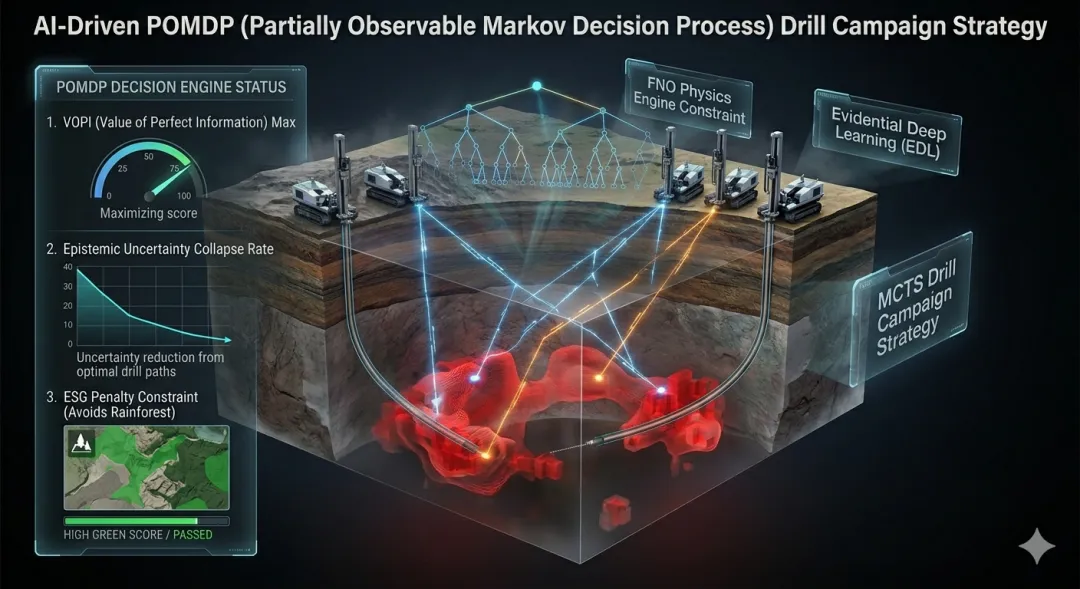
Alternative geological interpretations can be maintained as competing hypotheses: one graben or several hydrothermal centres; a combined control by faults, lithological interfaces and redox fronts; or the possibility that the current set of hypotheses is insufficient. AI does not need to select one story at the outset. It can maintain a belief state—a probability distribution over alternatives—and update the weights when new core, lithology, alteration, mineralization, grade and thickness data arrive.
In simplified form:
New belief ∝ likelihood of the observation under a hypothesis × prior belief
If a hole contradicts Model A, the weight of A should fall. If it is more consistent with Model B, the weight of B should rise. Drilling no longer follows one fixed narrative to completion; every hole becomes evidence for the next decision.
A good hole is not always the highest-probability hole
Many “AI exploration” products stop at a prospectivity map and answer where potential currently appears highest. Drill optimization goes further: which next hole produces the greatest information value?
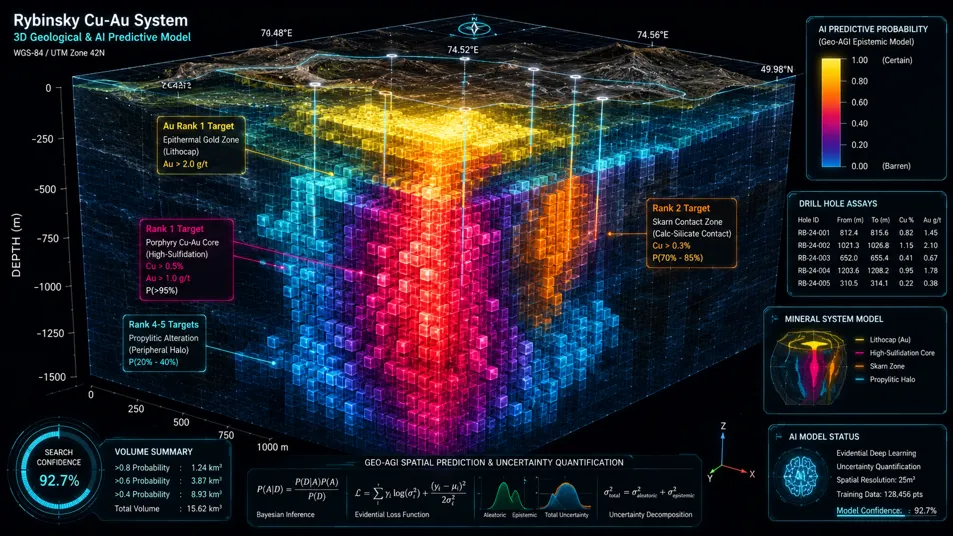
The answer is not always the location with the highest probability of mineralization. A hole with a lower apparent probability may distinguish two competing models particularly well. Even a barren hole can remove an incorrect direction and avoid much larger future waste.
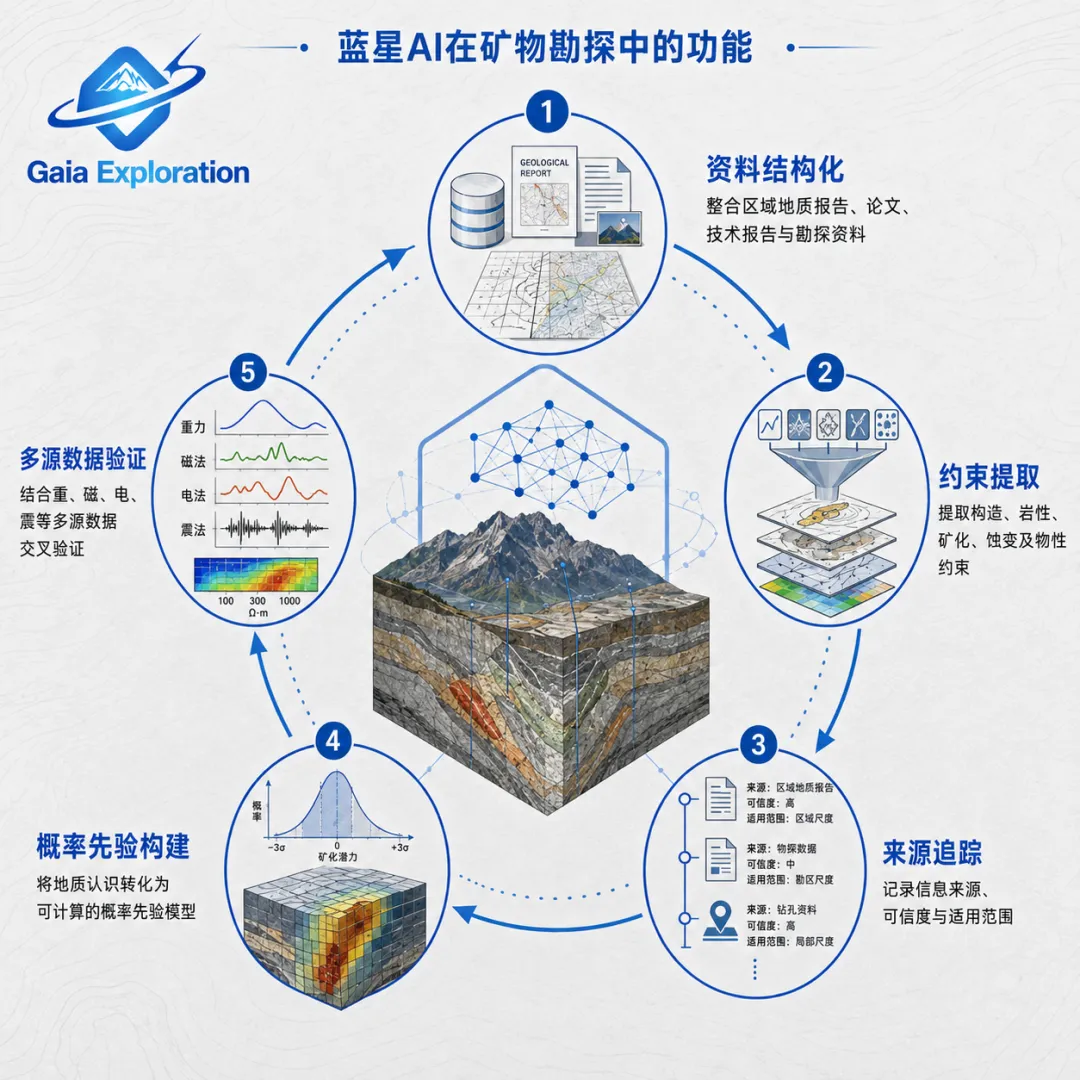
A closed-loop program has four recurring actions: organize existing drilling, geology, geophysics, geochemistry, remote sensing, structure and regional context; update the credibility of hypotheses; compare candidate holes by information value, validation value and economic relevance; then select the next hole and feed its result back into the model.
In sediment-hosted copper, for example, mineralization often relates to redox interfaces, basin architecture, fluid pathways and favourable stratigraphy. A useful model cannot merely produce a red area. It must formulate testable questions: Are there one or several graben domains? Are fluid paths focused or dispersed? Do favourable horizons and structures overlap? Do drilled lithology, alteration and mineralization support the current story?
The professional value of optimization is to explain why a hole should be drilled and let core, assays and later holes test that reason.
The null hypothesis is a brake for the budget
The most dangerous exploration state is not always failure. It is a project that has drifted away from a credible direction without recognizing it. Sunk cost, interpretive inertia and organizational pressure can keep holes moving along the same model. Each result is described as “almost there” even when the overall evidence no longer supports the narrative.
A null hypothesis can be represented as a random model in which mineralization has no meaningful spatial structure and the human geological model explains the observations no better than chance. If the proposed model consistently fails to outperform that null as drilling advances, the story should be paused, rebuilt or abandoned.
This does not guarantee discovery. It helps identify which hypotheses remain worth testing, which targets require reranking, which explanations lack support and where spending should wait for new data or a better model. Valuable mining AI should help a team decide not only where to accelerate, but also when to stop.
GAIA: an evidence chain is more valuable than a heat map
Exploration data are never naturally consistent. Geology, geophysics, geochemistry, remote sensing, spectroscopy, drillholes, samples, coordinates, units and terminology often come from different decades, teams and standards. Without data governance, a sophisticated model can simply amplify original errors.
GAIA starts by making the structure of evidence visible: what supports the target, what conflicts, and which critical data are absent. Outputs must then be constrained by mineral-system mechanisms. Different commodities, belts, deposit types and cover conditions require different controls and tests. AI changes how information is organized and ordered; it does not change geology.
Every target returns to field validation. AI produces an exploration hypothesis, not a confirmed body, resource or commercial result. New core, logging, assays and interpretations must update the evidence and the model.
What the Mingomba example teaches
The Mingomba copper case in Zambia is often discussed as an example of AI-supported deep-exploration decisions. The cited depth context is approximately 1,500 metres, with limited direct surface expression. Its transferable lesson is not that an algorithm was magical. It is the typical logic of deep targeting: develop several models from regional geology, historical work and geophysics; update them with drill feedback; and design the next hole as an experiment that maximizes information gain.
Every hole should answer a clear question. A mineralized intersection updates the model; a barren intersection should still reduce uncertainty. This is the difference between optimization and the slogan of simply drilling fewer holes: each hole carries an explicit evidentiary task.
How to judge the value of exploration AI
AI does not diminish professional geological experience. A strong workflow depends more heavily on high-quality hypotheses. The geologist’s role shifts from supplying one “correct” answer to constructing meaningful competitors. The clearer the mineral system, controls, anomaly associations and test logic, the more effectively AI can work on the right problem.
Investors should not judge an AI exploration project only by model size, computing spend or presentation. A robust review asks at least five questions: Where did the data come from and how were they governed? Is the geological logic behind target ranking clear? Are predictions, hypotheses and verified facts kept distinct? Are validation and stopping rules defined? Does each field result enter the next decision round?
More directed drilling may also reduce unnecessary disturbance and resource consumption under stronger ESG constraints, but that benefit remains project-specific and must be demonstrated. Trustworthy mining AI must withstand geological review, field validation and capital discipline together.
Conclusion: closing the loop in deep exploration
AI drill optimization is not about a machine guessing where ore lies. It is about moving exploration from static prediction to dynamic decision-making. POMDPs provide a framework for a hidden underground state, Bayesian updating absorbs new evidence, and null-hypothesis testing prevents a failing story from consuming the budget indefinitely.
Together they move deep exploration from fragmented glimpses toward closed-loop verification. The next hole is not just a coordinate. It should be a decision jointly constrained by evidence, model updates and an explicit field test.